පූර්ණ ශ්රේෂ්ඨාධිකරණ විනිසුරු මඩුල්ලක්?
22 වන ආණ්ඩුක්රම ව්යවස්ථා සංශෝධනයට එරෙහිව ඉදිරිපත් කර තිබෙන පෙත්සම් පූර්ණ ශ්රේෂ්ඨාධිකරණ විනිසුරු මඩුල්ලක් ඉදිරියේ විභාගයට ගන්නා ලෙසට පෙත්සම්කාර පාර්ශව කළ ඉල්ලීම ශ්රේෂ්ඨාධිකරණය ප්රතික්ෂේප කළේ ය.

22 වන ආණ්ඩුක්රම ව්යවස්ථා සංශෝධනයට එරෙහිව ඉදිරිපත් කර තිබෙන පෙත්සම් පූර්ණ ශ්රේෂ්ඨාධිකරණ විනිසුරු මඩුල්ලක් ඉදිරියේ විභාගයට ගන්නා ලෙසට පෙත්සම්කාර පාර්ශව කළ ඉල්ලීම ශ්රේෂ්ඨාධිකරණය ප්රතික්ෂේප කළේ ය.
The Bar Association of Sri Lanka (BASL) has alleged that due to the failure on the part of President Anura Kumara Dissanayake to fill the existing vacancies in the Supreme Court, a Senior Justice of the Court of Appeal, Justice Dhammika Ganepola, retired at the age of 63 without being considered for, or granted, a promotion to the Supreme Court, to which he was well entitled. The BASL pointed out at the time of Ganepola’s retirement there were four vacancies in the Supreme Court.
In a letter dated 17 August, 2026, addressed to President Dissanayake, the BASL declared that the failure to promote and recognise Ganepola’s distinguished judicial service, resulting in his retirement at the age of 63, is indeed a loss to the Judiciary.
A top BASL spokesman told The Island yesterday (30) that the Bar Council, over the weekend, had decided to release the hitherto confidential letter.
The official said that they also wanted to remind the President of his assurance given to BASL, on 12 August, 2026, that vacancies in the Supreme Court and Court of Appeal would be filled as soon as possible, within a month.
The following is the text of the BASL letter, signed by Rajeev Amarasuriya, President, BASL, and its Secretary Nalin De Silva: “We write further to our letters dated 29th December 2025 and 30th June 2026 in relation to the above, to which we have not received any response.
We also refer to our meeting with Your Excellency on 12th August. As discussed during the meeting, there have been vacancies in the Supreme Court since May 2025, and the number of vacancies has now increased to four (04). There are also four (04) vacancies in the Court of Appeal. These are all matters we have already written to Your Excellency about.
Your Excellency informed the BASL Delegation when we met that you would be taking steps to make recommendations to fill these vacancies as soon as possible, within a month.
We write to reiterate the importance of giving due consideration to the criteria set out in our aforesaid letter dated 29th December 2025. We also wish to emphasise that, in making judicial appointments and promotions, seniority should be given due priority, in keeping with longstanding practice, until such time there are objective and defensible guidelines governing the assessment of merit.
The only justifiable departure to this criterion would be where there exists a specific and recognized demerit in respect of the particular Judge concerned or such other known compelling circumstances that are objectively identifiable such as where a Judge has previously been overlooked for promotion unfairly or conversely, where a Judge has been unfairly previously granted promotions above others.
This approach will safeguard both the integrity of the Judiciary and the trust reposed in it by the public.
Further, while there has been considerable discussion and representation by the Government regarding the importance of retaining experienced judges, as reminded to Your Excellency at our said meeting that, only a few months ago on 8th May 2026, a Senior Justice of the Court of Appeal, Justice Dhammika Ganepola, retired at the age of 63 without being considered for, or granted, a promotion to the Supreme Court, to which he was well entitled, and in which there were four vacancies at the time.
The failure to promote and recognise his distinguished judicial service, resulting in his retirement at the age of 63, is indeed a loss to the Judiciary.
We also drew Your Excellency’s attention at the said meeting to the fact that the Senior-most Justice of the Court of Appeal, Justice R. Gurusinghe, who joined the Judicial Service in 1996, who also Acted in the Office of President of the Court of Appeal (appointed by Your Excellency) on 11th May 2026, is due to retire at the end of this month. In fact, we learnt through the Media that Her Ladyship then Chief Justice Justice Murdu Fernando, PC, had previously in July 2025 recommended to Your Excellency the promotion of Justice R. Gurusinghe to the Supreme Court, but the same is pending from that time.
He too is well deserving of promotion to the Supreme Court and has already been recommended by the former Chief Justice, and his case must also receive due and urgent consideration before his impending retirement.
We hope that Your Excellency will take due note of and give due regard to the concerns of the Bar, as well as to the established principles, practices and conventions governing judicial appointments, when taking steps to fill these vacancies.
On this, Your Excellency is already open to the accusation that these vacancies have been kept open, to fill with favourites of the Government which is yet another serious indictment on the independence of the judiciary which accusation would be confirmed if recommendations are made outside established practice.
Moreover, the BASL expresses grave concern that withholding promotions of Judicial Officers for extended periods of time places undue pressure on Judicial Officers in the discharge of their duties and constitutes both directly and indirectly, interference with the independence of the Judiciary, in addition to the strain obviously caused to the dispensation of justice in other Courts and the stifling and delay of career progression of Judges legitimately entitled to promotions.
We do hope that Your Excellency would take due note and cognizance of the foregoing when effecting these judicial promotions which have been long overdue and which have already adversely impacted the efficiency and effectiveness of the administration of justice.”
The BASL has copied the letter to Prime Minister Dr. Harini Amarasuriya, Speaker Dr. Jagath Wickremaratne, Opposition Leader Sajith Premadasa and all members of the Constitutional Council.
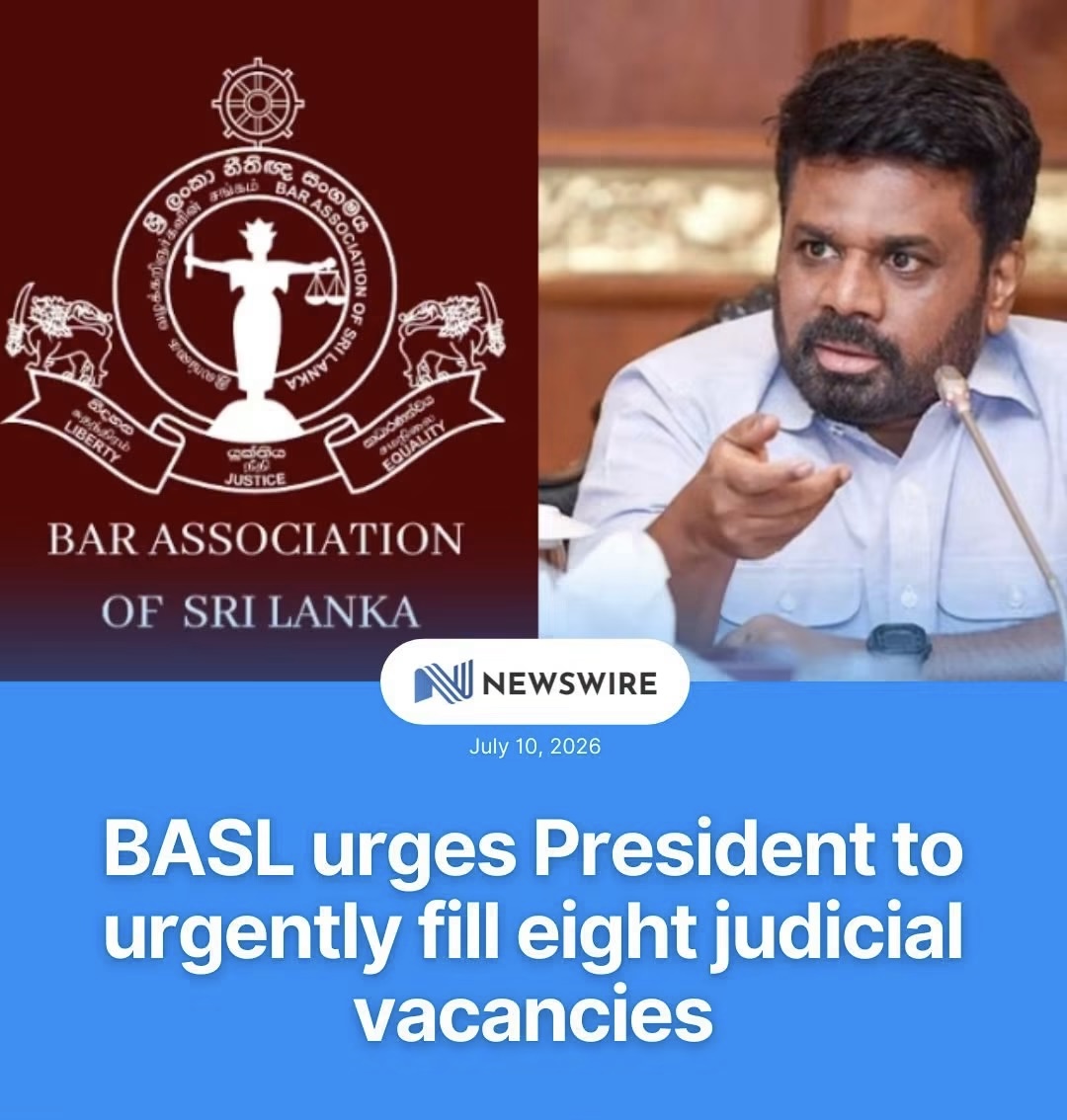
The Bar Association of Sri Lanka (BASL) has urged President Anura Kumara Dissanayake to take immediate steps to fill four vacancies in the Supreme Court and four vacancies in the Court of Appeal, warning that the prolonged delay could undermine the administration of justice and public confidence in the Judiciary.
In a letter addressed to the President, the BASL said the continued vacancies have placed a significant burden on both courts, which are operating with nearly 25% fewer judges than their full complement, potentially affecting the timely disposal of cases.
The association also expressed concern that the delay could fuel speculation over the judicial appointments process, including perceptions that appointments are being postponed for particular individuals, which it said could erode confidence in the independence and integrity of the Judiciary.
The BASL further noted that it is still awaiting a response to its previous letter raising concerns over the reported proposal to amend the Constitution to increase the retirement age of Supreme Court and Court of Appeal judges, warning that such a move could also have implications for judicial independence. (Newswire)

The Human Rights Commission of Sri Lanka (HRCSL) has launched an investigation into the recent Negombo Prison violence, while also probing reports of torture and ill‑treatment of prisoners transferred to other facilities. In a letter copied to the President and key ministers, the HRCSL expressed concern after its Rapid Response Unit was denied entry to Welikada Prison on July 7, stressing its legal mandate to inspect prisons at any time. The Commission directed the Commissioner General of Prisons to grant unimpeded access to HRCSL staff and fully cooperate with the ongoing probe.
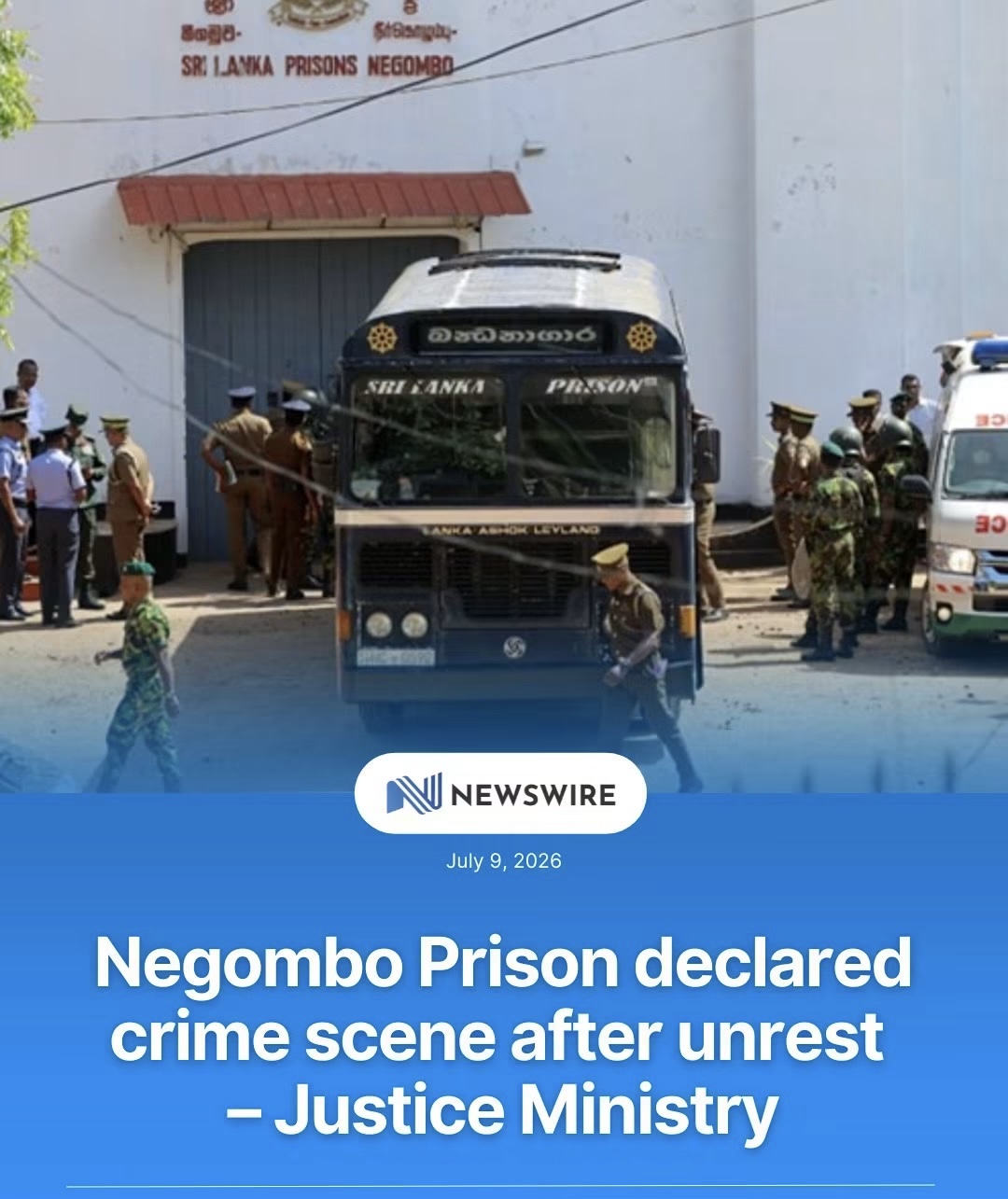
The Ministry of Justice has announced that the Negombo Prison, severely damaged during the July 5–6 unrest and designated a crime scene, is unsuitable to house inmates. To facilitate investigations, ensure prisoner safety, and begin rehabilitation work, most inmates have been transferred to other facilities. The ministry said regulations have been issued to temporarily establish the Mahara and Old Bogambara premises as prisons under the Prisons Ordinance.
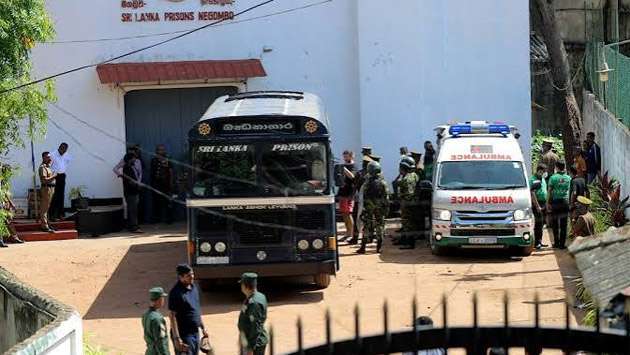
Colombo, July 8 (Daily Mirror) – Two inmates transferred from Negombo Prison following the recent unrest have died.
One inmate who was relocated to Angunakolapelessa Prison died after being transferred there, while another inmate sent to Boossa Prison passed away following a sudden illness after being admitted to the Karapitiya Hospital in Galle.
A total of 1,033 inmates who were held at the Negombo Prison have been transferred to various correctional facilities across the country following the unrest.
Among those transferred to Boossa Prison is an inmate known as “Katuwellegama Suresh,” who has been accused of leading the violent confrontation inside the prison.
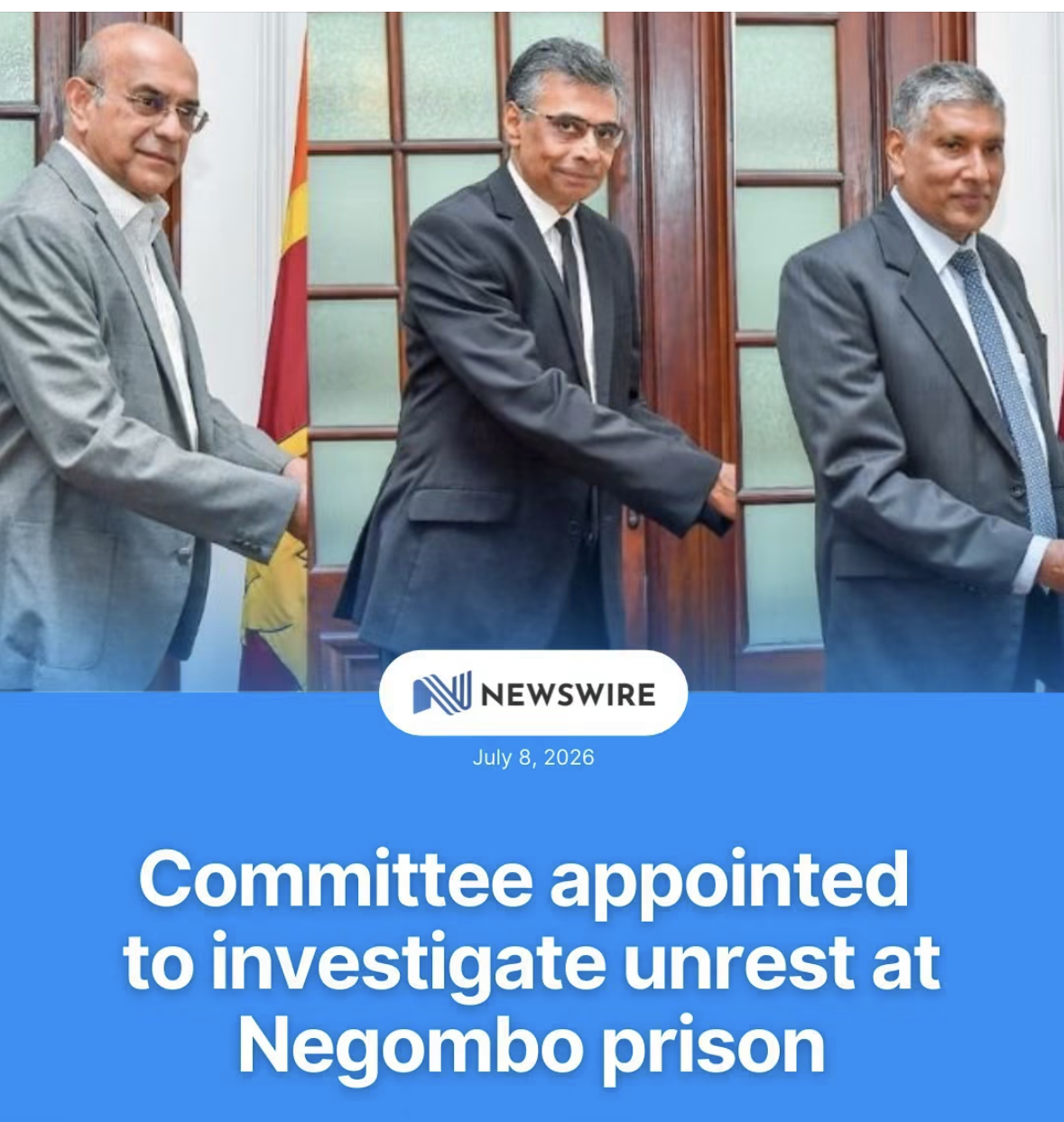
A Committee of Inquiry was appointed today (07) by Secretary to the President Dr Nandika Sanath Kumanayake, with Cabinet approval, to conduct a comprehensive investigation into the unrest that occurred at Negombo Prison on 5 and 6 July and to report on the circumstances that led to the incident.




The Committee for Protecting Rights of Prisoners has urged authorities to immediately halt the alleged assaults and torture of inmates transferred from Negombo Prison after recent unrest. In a media release issued today, the Committee said credible reports indicate prisoners moved to facilities such as Welikada have been severely beaten by prison officers. The Committee called on all responsible officials to ensure prisoner protection and uphold human rights standards without delay
WHEN VENGEANCE BECOMES GOVERNANCE-Ali Sabry
When the principal mission of a government becomes the pursuit, arrest, detention and prosecution of its political opponents and predecessors, it should surprise no one when the actual work of governing begins to suffer.
There are only so many hours in a day. Only so much institutional capacity. Only so much political attention.
If every waking hour is consumed by deciding who should be summoned next, who should be arrested, who should be detained, who should be prosecuted, who should be intimidated and who should be publicly humiliated, there will inevitably be little time, energy or imagination left for the far more difficult task of governing a country.
Perhaps that explains much of what we see today.
Dengue threatens lives and families across the country. Where is the urgency, coordination and national mobilisation that such a public health threat demands?
Our prisons are bursting at the seams, overcrowded beyond dignity and reason. Where is the serious policy response?
Farmers are clamouring for a reasonable price for their produce and a fair return for their labour. Where is the solution?
Ordinary people continue to struggle with the cost of living, livelihoods and uncertainty. Where is the sustained focus?
These are not distractions from governance.
These are governance.
Governance is difficult. It demands competence, discipline, prioritisation, imagination and relentless attention. It requires a government to solve problems rather than manufacture enemies. It requires ministers to deliver, institutions to function and the machinery of the State to serve the citizen.
Vengeance is considerably easier.
An arrest creates a headline.
A detention creates a spectacle.
A prosecution can be presented as performance.
The public humiliation of an opponent may offer a moment of sardonic pleasure to those intoxicated by power.
But a handcuff is not a health policy.
A remand order is not an agricultural policy.
A prosecution is not an economic programme.
And a prison cell is not evidence of good governance.
None of it eradicates dengue.
None of it reduces prison overcrowding.
None of it gives the farmer a fair price.
None of it creates a job, improves a school, strengthens a hospital, grows an economy or makes life easier for a family struggling to survive.
A government cannot indefinitely sell arrest, detention, imprisonment and prosecution as a substitute for performance. Nor can every act of political vengeance be repackaged forever in the language of accountability and good governance.
By all means, let the law take its course.
Where there is credible evidence, investigate.
Where the law warrants prosecution, prosecute.
Let independent courts decide.
But the law must take its own course, not a course politically charted for it.
Investigations must be lawful, professional and impartial. Prosecutions must be evidence based, not appetite driven. Due process must be respected. The presumption of innocence must have real meaning. The separation of powers must exist not merely as elegant words in a Constitution, but as a living restraint on those who temporarily exercise state power.
The Executive is not the investigator, prosecutor, judge and jailer rolled into one.
The Judiciary is not an extension of the Executive. It is not there to facilitate the political objectives of the government of the day. Its independence must be clearly understood, vigilantly protected and unreservedly respected.
There is also a warning from history that no government should ignore.
Power is temporary.
Precedents endure.
The machinery of coercion you celebrate today may be inherited by someone else tomorrow. The safeguards you weaken to punish your opponents will not miraculously reappear when you need their protection. The standards you destroy in the name of vengeance may one day become the standards by which you yourselves are treated.
And there lies the greatest irony.
A government so consumed by pursuing its predecessors may eventually discover that it neglected the country, disappointed the people and prepared the very instruments that may one day be turned against itself.
You may then end up in a far worse place than the very predecessors you condemned.
Justice is essential.
Accountability is essential.
The rule of law is non negotiable.
But vengeance is not governance.
And when vengeance becomes the mission of government, governance becomes its first casualty.
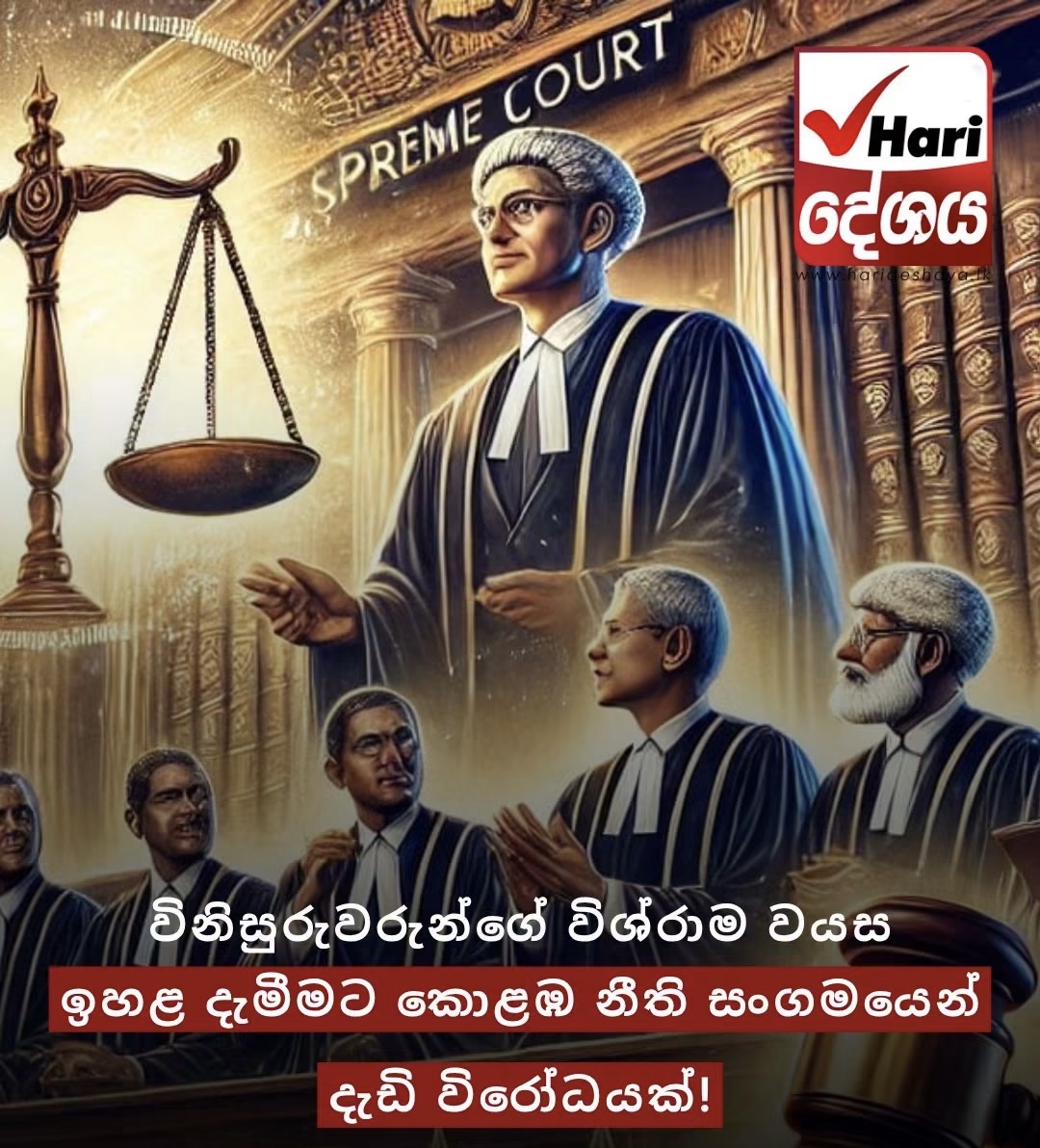
විනිසුරුවරුන්ගේ විශ්රාම වයස ඉහළ දැමීමට කොළඹ නීති සංගමයෙන් දැඩි විරෝධයක්!
ශ්රේෂ්ඨාධිකරණය සහ අභියාචනාධිකරණයේ විනිසුරුවරුන්ගේ විශ්රාම ගැන්වීමේ වයස් සීමාව දීර්ඝ කිරීම සඳහා කිසිදු ආණ්ඩුක්රම ව්යවස්ථා සංශෝධනයක් සිදු කිරීමෙන් වළකින ලෙස කොළඹ නීති සංගමය (CLS) ජනාධිපති අනුර කුමාර දිසානායක මහතාගෙන් ලිඛිත ඉල්ලීමක් කර තිබේ.
උසස් අධිකරණ විනිසුරුවරුන්ගේ විශ්රාම වයස ඉහළ නැංවීමට රජය සූදානම් වන බවට පැතිර යන වාර්තා සැලකිල්ලට ගනිමින්, එම සංගමයේ විධායක කමිටුව ඒකමතිකව මෙම තීරණයට එළඹ ඇත. මේ සම්බන්ධයෙන් ශ්රී ලංකා නීතිඥ සංගමය (BASL) මීට පෙර ප්රකාශ කළ දැඩි ස්ථාවරයට ද කොළඹ නීති සංගමය සිය පූර්ණ සහාය පළ කර තිබේ.
ව්යවස්ථාමය ස්ථාවරත්වය සහ මහජන විශ්වාසය පළුදු වීම
අධිකරණයේ ස්වාධීනත්වය සහ අපක්ෂපාතීත්වය ප්රජාතන්ත්රවාදී පාලනයක ප්රධානතම පදනම වන බැවින්, දේශපාලන අවශ්යතා මත ඊට මැදිහත් නොවිය යුතු බව නීති වෘත්තිකයෝ පෙන්වා දෙති. කොළඹ නීති සංගමය පෙන්වා දෙන ප්රධාන කරුණු මෙසේය:
දීර්ඝකාලීන සම්ප්රදාය බිඳවැටීම: 1978 ආණ්ඩුක්රම ව්යවස්ථාව මෙරට ක්රියාත්මක වූ දා සිට අද දක්වා ශ්රේෂ්ඨාධිකරණ සහ අභියාචනාධිකරණ විනිසුරුවරුන්ගේ විශ්රාම වයස් සීමාවන් වෙනස් කර නැත. එවැනි දීර්ඝකාලීන නීතිමය රාමුවක්, විශේෂයෙන්ම දැනට ධූර දැරීමේ නිරතව සිටින විනිසුරුවරුන්ට ද බලපාන අයුරින් ක්ෂණිකව වෙනස් කිරීම තුළින් අධිකරණයේ ස්වාධීනත්වය පිළිබඳ ජනතාව තුළ පවතින විශ්වාසය දැඩි ලෙස බිඳ වැටිය හැකිය.
හදිසි අවශ්යතාවක් නොමැති වීම: පසුගිය 2020 වසරේදී සිදු කරන ලද ව්යවස්ථා සංශෝධන මඟින් ශ්රේෂ්ඨාධිකරණයේ සහ අභියාචනාධිකරණයේ විනිසුරුවරුන් සංඛ්යාව දැනටමත් ඉහළ නංවා තිබේ. එබැවින් වත්මන් තත්ත්වය තුළ විනිසුරුවරුන්ගේ විශ්රාම වයස වෙනස් කිරීමට තරම් හදිසි හෝ අත්යවශ්ය ආයතනික අවශ්යතාවක් මතු වී නොමැත.
පුළුල් උපදේශනයක අවශ්යතාව
උසස් අධිකරණවල විනිසුරුවරුන් මෙරට යුක්තිය පසිඳලීමේ පද්ධතිය වෙනුවෙන් සිදු කරන වටිනා සේවය අගය කරන නමුත්, ව්යවස්ථාවෙන් තීන්දු කර ඇති මෙවැනි සංවේදී කාරණයක් හිතුවක්කාරී ලෙස වෙනස් නොකළ යුතු බව සංගමය අවධාරණය කරයි.
“විශ්රාම වයස සංශෝධනය වැනි තීරණයක් ගන්නේ නම්, ඊට ප්රථමයෙන් නීති ක්ෂේත්රයේ සියලුම හවුල්කරුවන් සහ අදාළ පාර්ශ්වයන් සමඟ ඉතා පුළුල් ලෙස සාකච්ඡා කර එකඟතාවන් ලබාගත යුතුය.”
නීති වෘත්තියේ නිරත පිරිස් පෙන්වා දෙන මෙම බරපතළ කරුණු කෙරෙහි පූර්ණ අවධානය යොමු කර, අධිකරණ පද්ධතිය කෙරෙහි මහජනතාව තබා ඇති විශ්වාසය ආරක්ෂා කරන ලෙස කොළඹ නීති සංගමය ජනාධිපතිවරයාගෙන් වැඩිදුරටත් ඉල්ලා සිටී.
මෙම නිල ලිපියේ පිටපත් අග්රාමාත්ය හරිනි අමරසූරිය, අධිකරණ අමාත්ය හර්ෂණ නානායක්කාර සහ ශ්රී ලංකා නීතිඥ සංගමයේ සභාපති රජීව් අමරසූරිය යන මහත්ම මහත්මීන් වෙත ද යොමු කර තිබේ.